Recovery is Holistic
Healing isn’t just physical — sleep, nutrition, and emotion shape recovery too.
Community Builds Motivation
Shared progress turns isolation into encouragement and accountability.
What I Learned
Move with confidence,
train anywhere.
AirHealth’s mission is to help anyone move with confidence and turn any space into a training space. For the business, that meant a daily habit, not a one-time download.


Research
Plenty of apps. No one is in the room
Workout apps tell you what to do. Trackers show you what you did. None of them answer the questions people ask at home: Is my form right? Should I push or rest? Am I actually improving? That gap is where AirHealth fits.


Major improvements in the design
In testing, users skipped the generic “Body has recovered well” message. They wanted proof. Motivation came from their own data, not words. The redesign puts a readiness score built from sleep, activity and SpO₂ at the top, so users know why today’s workout fits them.
The product
Get the highlights
Partnership
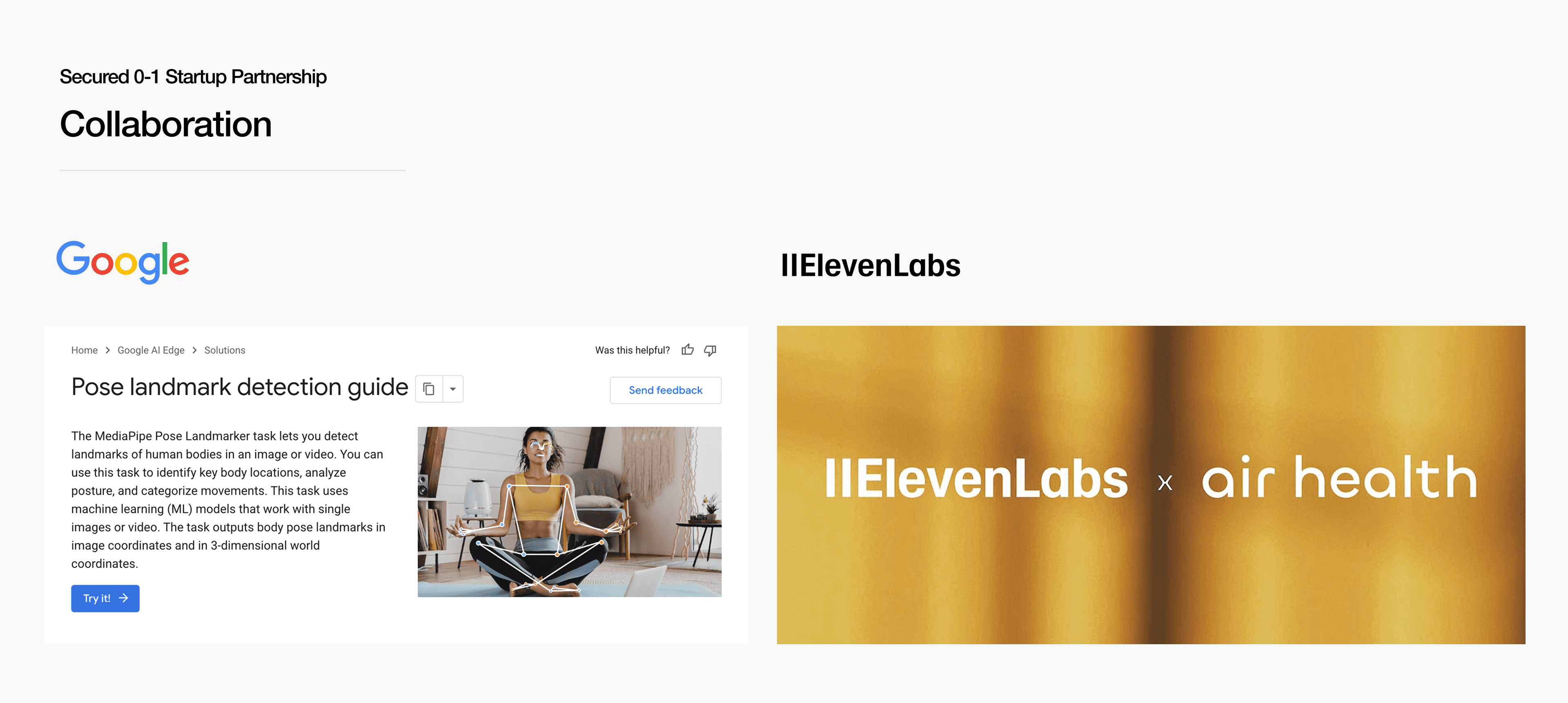
The technical architecture leverages Google MediaPipe for precise on-device motion tracking and ElevenLabs to deliver empathetic, human-like voice guidance.
Air Health
Only 23% of US adults meet CDC exercise guidelines. Expert coaching is out of reach, and most apps tell you what you did, not how well you did it.
I led product design for AirHealth, an AI coach that checks your form through the phone camera and adapts your plan to how your body feels.
Problem
Only 23% of US adults meet CDC exercise guidelines. 46% own a wearable, a market headed to $13.1B by 2030, but tracking alone doesn’t coach you. Most people stop because their plan never adapts and they can’t tell if their form is right.
Outcome
$600K Accelerator Funding for AirHealth
Validated through moderated usability tests and an on-device prototype that cut design-to-tested-interaction time by 60%. AirHealth secured $600K in seed funding, with another $600K in active talks
Listen
Understanding
people’s mental models
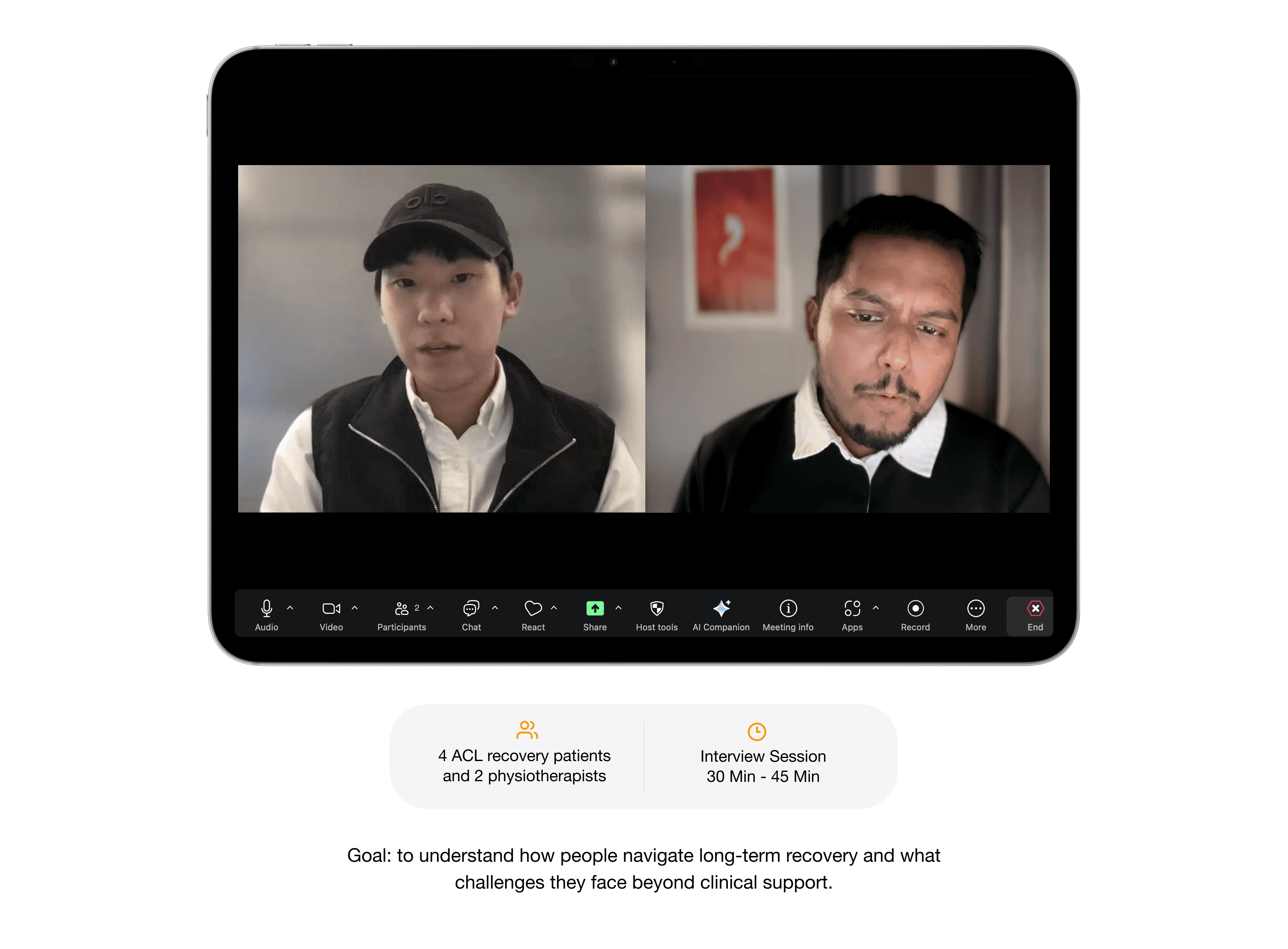
I talked to people who had finished PT and to physiotherapists to learn what happens once the clinic visits end, and why home exercise falls apart.
Scalable Design System & Tokens
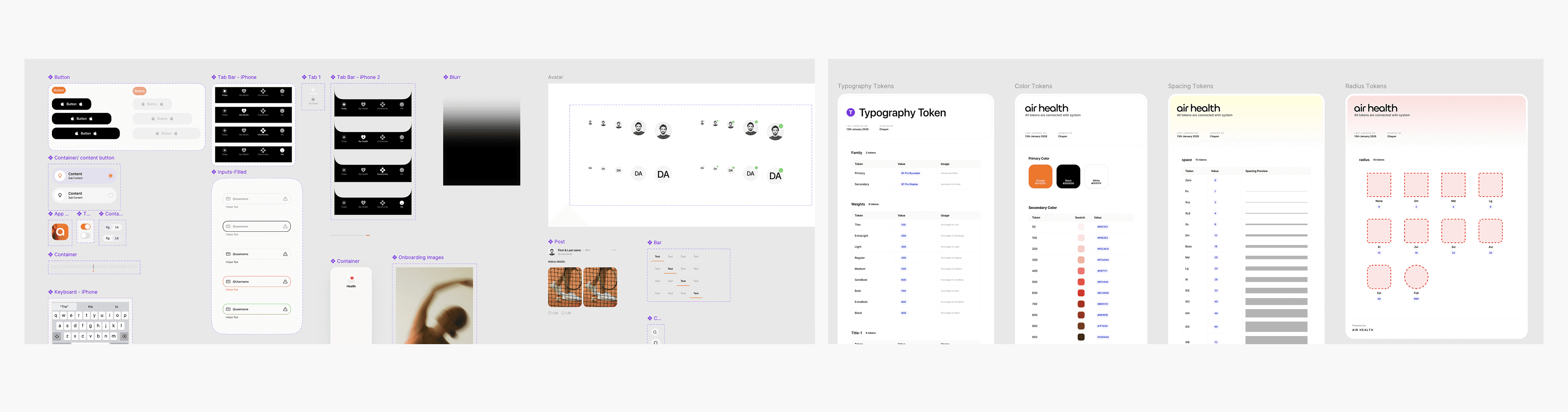
To support AirHealth’s rapid development, I moved beyond static components to a semantic token architecture. This system maps design variables directly to code, ensuring seamless engineering handoff and 1:1 implementation accuracy for the MVP
User Problem
“Most patients give up after a week.”
It’s not that they don’t care. At home, the plan never adapts to how they feel, nobody tells them if they’re doing it right, and one missed day feels like failure.

How might we
Help people stay consistent at home when their plan doesn’t adapt and no one tells them if they’re doing it right?
Key Insight
People don’t quit because the exercises are hard. They quit because they can’t tell if it’s working. A fixed plan on paper can’t adapt to a bad day or show progress, so motivation fades.
Iteration
Test to
validate design
We tested each version with users and refined the home screen step by step. Early designs showed progress but didn’t explain it. The final design starts with a readiness score, so you know how your body feels before you see the plan.
What I could have done better
More Iterative Testing
Testing across all recovery phases could refine personalization further.
Broader Inclusivity
Involving users with diverse routines and lifestyles would widen insights.

Solution
A daily plan that adapts to how your body feels and coaches you while you move. A morning readiness score sets the day’s workout, live posture guidance corrects your form, and streaks keep you coming back.

Smart Guidance
A real time coach that checks your full body, tracks your posture as you move, and lets you adjust the overlay, video and audio anytime.

After Workout
After each session you get a summary of the muscles you worked and tips on your form. You also log how your pain feels, so tomorrow’s plan can adapt.


Nutrition
Recovery is our core user. These are people working out at home after a sports injury, often out for 5 to 6 months. Exercise alone can’t stop them from losing muscle in that time, but nutrition can. Adding meal tracking and recipes gave them a reason to open AirHealth every day, not just on workout days.
Health Progress
Users can see their progress in one place. Based on their daily data, like heart rate, nutrition and activity, AirHealth calculates their health age, so they know whether their body is getting healthier over time.

AI Coach
Recovery brings daily questions, like whether to train today or what to eat after a workout. The AirHealth coach answers them using the user’s own data, so they get advice that fits their body, not a generic search result. The friendly character makes asking feel easy, not clinical.
Community
Recovery can feel lonely, so we added a space where users share workouts and cheer each other on. Early versions had a leaderboard and challenges, but ranking people by points pushed them to compare and overdo it. Recovery isn’t a race, so the final design keeps only Feed and Friends, to focus on support, not competition.
Prototyping
I didn’t stop at Figma. I built the key flows in SwiftUI with AI and tested them on a real phone, which cut prototype to test time by 60%. Testing live camera tracking, real gestures and real timing showed problems that a clickable Figma prototype would have hidden
What next?
We’re now adding lab results. Once users connect their blood work, AirHealth can see things like vitamin D, iron or inflammation levels and suggest a workout plan that fits what their body actually needs, not just how they feel that day.


